
How to evaluate a detox center starts with looking beyond marketing materials and appearances. The most important factors are the quality of medical care, clinical experience, safety protocols, accreditation, staff qualifications, and how the program supports recovery after detox. Asking informed questions about these areas can help you choose a facility that meets your needs rather than relying on first impressions alone.
And with alcohol detox, things can get complicated fast. Withdrawal isn’t just uncomfortable, it can escalate into something genuinely dangerous, including seizures and a condition called delirium tremens, within hours. That’s why the facility you choose, and the clinical team behind it, matters far more than most people realize when they’re in the middle of trying to decide.
This guide is built around one idea: you deserve to walk into any admissions call with the right questions already in hand. Not vague, feel-good questions. Specific ones. The kind that reveal whether a center offers real alcohol detox near me with genuine medical oversight or something that only looks like it from the outside.
Seven core areas to evaluate:
- Licensing and accreditation status
- Medical supervision and withdrawal protocols
- Aftercare and transition planning
- Insurance coverage and cost transparency
- Staff-to-patient ratios and individualized care
- Co-occurring mental health and dual diagnosis support
- Red flags that signal you should keep looking
Is the Center Licensed and Accredited?
One of the clearest indicators of what makes a good detox center is legitimacy. A licensed and accredited facility has met established standards for safety, quality of care, and clinical practices through independent review. While credentials alone don’t tell the whole story, they provide an important level of accountability and reassurance when choosing a program where patient safety is a top priority.
Ask directly: Is this facility licensed by the state? Which accrediting bodies have reviewed and approved your programs? How recently was that accreditation renewed? You can cross-reference answers by searching the SAMHSA treatment locator, which only lists state-verified providers, or checking whether the center holds recognition from The Joint Commission or CARF International, two of the most rigorous independent accreditation bodies in behavioral health.
State licensure establishes a legal floor. Accreditation raises it. A facility with Joint Commission approval has been evaluated against a comprehensive set of clinical standards, staffing requirements, and patient safety protocols that go well beyond what licensing alone demands. That doesn’t automatically make it the “best” option for every person, but it does demonstrate a verifiable commitment to recognized standards of care.
Why Licensing Matters
Unaccredited facilities sometimes operate legally but without meaningful accountability. Licensing creates a documented relationship between the facility and a state regulatory body, which means inspections, required reporting, and consequences for violations. For someone entering a vulnerable phase of treatment, that accountability structure is one of the clearest signals that a center takes patient safety seriously.
Who Provides Medical Supervision?
Alcohol withdrawal carries clinical risks that separate it from most other substances. Benzodiazepine-based protocols, seizure monitoring, vital sign checks, these aren’t optional extras. They’re the baseline for responsible medical detox.
So ask: Are physicians or nurse practitioners on-site, or only on-call? Who specifically monitors withdrawal symptoms overnight? What’s the protocol if a patient’s condition deteriorates? What alcohol detox medications are available and under what criteria are they administered?
The answers tell you a lot. A facility that can speak clearly and specifically to its clinical protocols, including how it handles emergencies and how it adjusts medication-assisted treatment based on symptom severity, is operating from a place of genuine clinical competence. Vague answers about “monitoring patients closely” without detail about who does it or how often are worth probing further.
Why Medical Detox Matters
The NCBI’s clinical classifications outline distinct levels of withdrawal management, from Level 2-D ambulatory detox with extended monitoring to Level 3.7 medically monitored intensive inpatient services. Knowing where a facility sits on that spectrum helps you assess whether the intensity of care matches the clinical need. Unsupervised withdrawal from alcohol isn’t just unpleasant, it can be fatal. That’s not alarmism. It’s physiology.
| Question to Ask | Reassuring Answer | Worth Clarifying Further |
| Who monitors patients overnight? | On-site nursing staff | “Our team checks in regularly” |
| How are emergencies handled? | Clear on-site protocol and hospital transfer plan | “We handle everything internally” |
| What medications are available? | FDA-approved protocols based on CIWA scoring | “We use a natural approach” |
| How individualized is the plan? | Assessment-driven, adjusted daily | “Everyone follows the same process” |
What Does Aftercare Look Like?
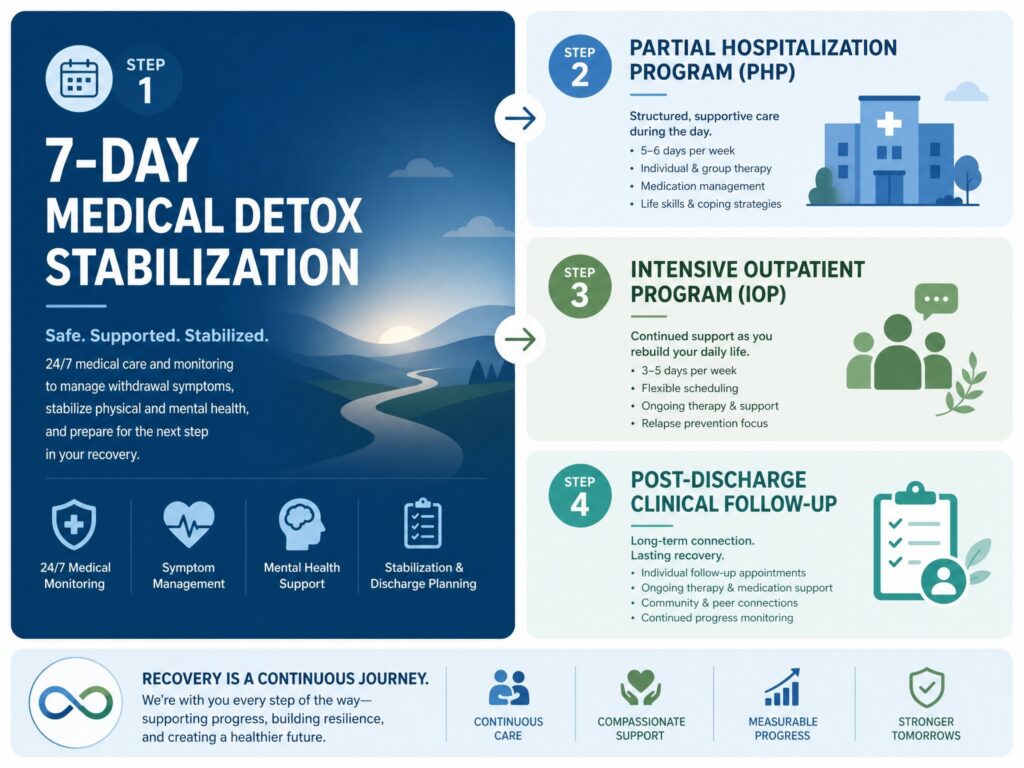
Detox ends a physiological dependence. It doesn’t end addiction. And the transition period right after discharge is one of the highest-risk windows in the entire recovery process. That reality makes aftercare planning not a bonus feature but a clinical necessity.
Ask whether the center builds a discharge plan before you leave, not the day of. Ask whether they offer or coordinate with outpatient programs, including Partial Hospitalization Programs or Intensive Outpatient Programs. Ask whether a clinician follows up after discharge or whether you’re handed a pamphlet and a handshake. According to the Hazelden Betty Ford Foundation’s guidance on how to choose a rehab center, facilities that include coordinated transition planning, not just a referral list, tend to produce better continuity of care.
One of the most important questions to ask a detox center is what happens after alcohol detox. A quality program doesn’t simply manage withdrawal and discharge you. Instead, the clinical team should help you develop a personalized continuing care plan, coordinate referrals when needed, and support a smooth transition into the next appropriate level of treatment to strengthen long-term recovery.
Good Centers Plan Beyond Detox
Recovery doesn’t follow a neat timeline. A 7-day medical detox that drops someone into no structure whatsoever is, frankly, a setup for relapse. Centers worth trusting have formalized relationships with PHP and IOP programs and treat discharge planning as part of the clinical process itself, not an afterthought scheduled on the last morning.
How Do They Handle Insurance?
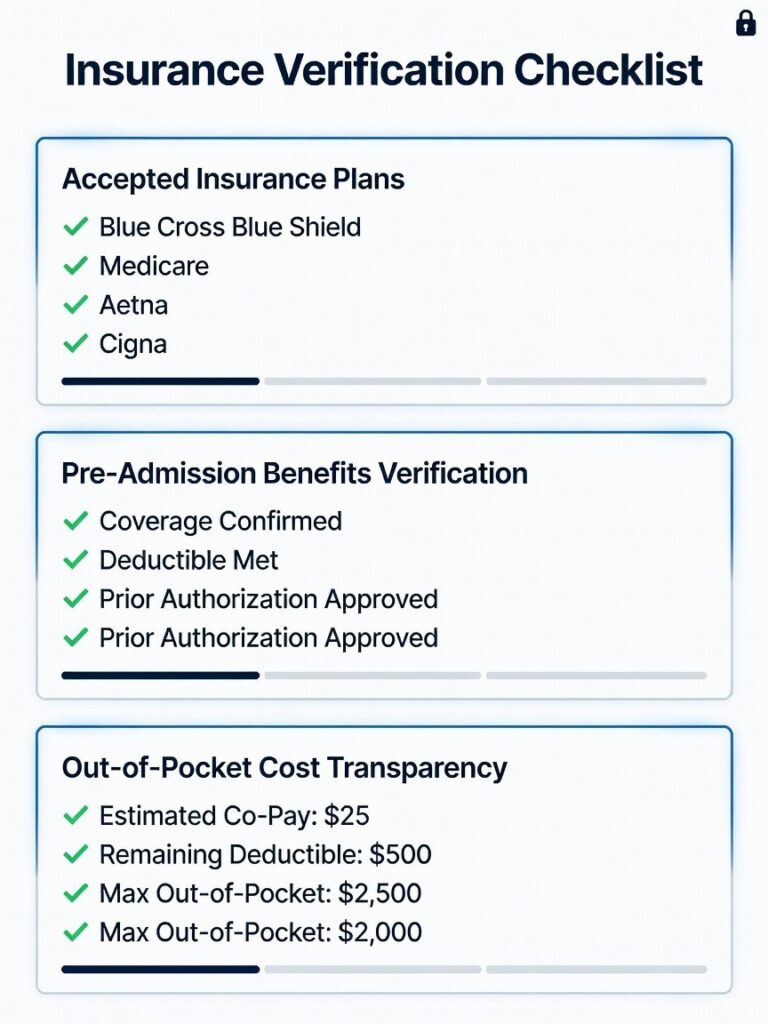
Financial ambiguity is one of the fastest ways a treatment decision stalls. You need clear answers before you commit, not after you’ve already arrived.
Ask which insurance plans the facility accepts, whether they’ll verify your benefits before admission, and what out-of-pocket costs you might be responsible for if coverage gaps exist. The NIAAA maintains a direct guide on what to ask treatment providers about costs and coverage, and the questions they outline are worth going through verbatim.
Understanding the full picture of alcohol detox cost before admission prevents situations where someone exits treatment owing thousands of dollars they weren’t prepared for, which creates its own kind of stress during an already fragile period. Payment plans, sliding scale options, and prior authorization support are all worth asking about explicitly.
What’s the Staff-to-Patient Ratio?
This one doesn’t always get asked, but it shapes everything else. How often a nurse actually checks on you. Whether a clinician has time to adjust your care plan mid-week. Whether someone notices early that your anxiety is spiking or that you’re not sleeping.
Ask how frequently patients are monitored throughout the day. Ask how accessible clinicians are during non-emergency situations. Ask who coordinates individualized care, and whether that person has a genuine caseload or whether you’re one of fifty people they’re tracking. The Hazelden Betty Ford Foundation and American Addiction Centers both point to lower staff-to-patient ratios as one signal of higher-quality attention, though what matters most is whether the staffing model actually allows for individualized treatment rather than one-size-fits-all management.
No single ratio is universally “right.” But if the answers feel evasive or the numbers seem implausibly stretched, trust that instinct.
Do They Treat Co-Occurring Conditions?

A significant percentage of people entering alcohol detox are also managing anxiety, depression, PTSD, trauma histories, or other mental health conditions that don’t pause for detox. A facility that treats only the substance piece without assessing the broader mental health picture is providing incomplete care, even if the medical detox itself is well-run.
Ask whether the facility screens for co-occurring mental health disorders during intake. Ask whether behavioral health professionals, not just addiction counselors, are involved in treatment planning. Ask how the clinical team coordinates when both substance use disorder and a mental health condition need simultaneous attention.
Dual diagnosis alcohol detox isn’t a specialty niche. It’s increasingly the standard of care, because the data consistently shows that untreated mental health conditions dramatically increase relapse risk. A detox program that can’t speak clearly to how it handles trauma or depression alongside withdrawal is leaving a major gap in care. Integrated treatment, where the same clinical team addresses both dimensions, tends to produce more durable outcomes than siloed approaches.
Red Flags That Should Make You Walk Away
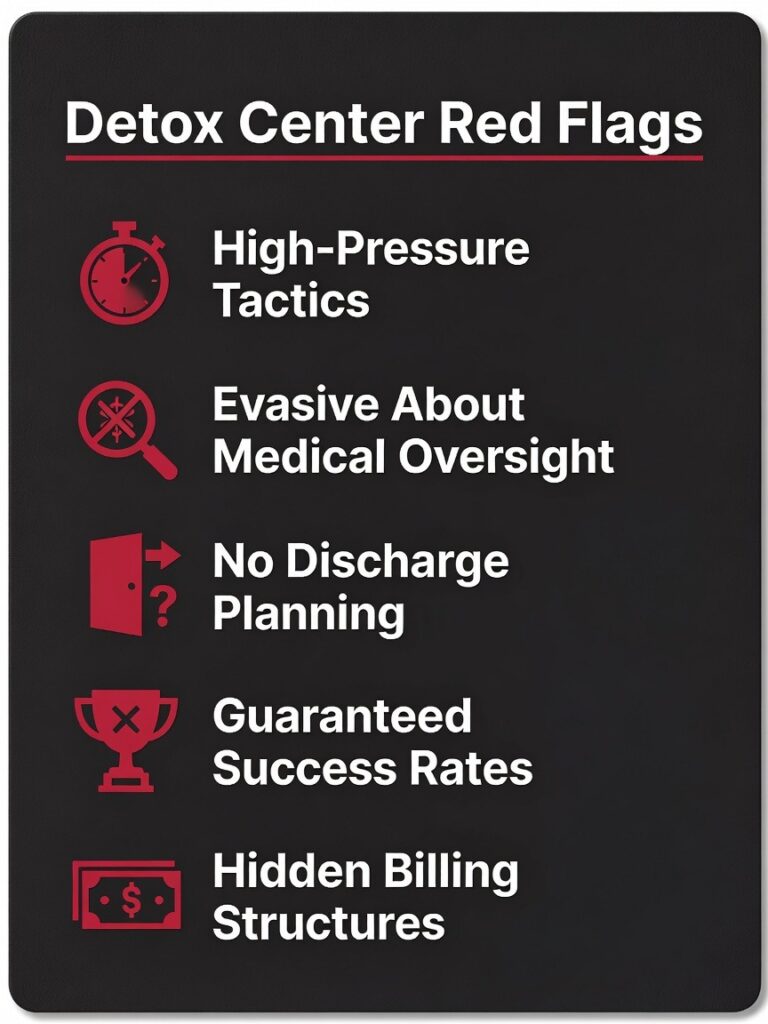
Some things that come up during an admissions call aren’t just imperfect, they’re signals worth taking seriously.
- Pressure to commit or sign paperwork before you’ve had time to ask questions
- Vague or evasive answers about who specifically provides medical oversight
- No mention of aftercare, discharge planning, or what comes next
- Guarantees of recovery or claims of unusually high success rates
- Upfront resistance to insurance verification or unclear billing structures
One concerning sign doesn’t automatically disqualify a facility. Patterns matter. If several of these show up in the same conversation, that’s worth pausing over. For a more detailed breakdown of what to watch for, the guide on alcohol detox center red flags covers the most common warning signs and how to tell the difference between minor friction and genuine cause for concern.
Why Kora Behavioral Health Meets These Standards
Kora Behavioral Health serves Lancaster and the surrounding communities of York, Harrisburg, Hershey, Reading, and Lebanon with an approach to alcohol detox built around exactly the kinds of questions this guide covers. Medical supervision that goes beyond check-the-box monitoring. Individualized care plans adjusted based on clinical response. Dual diagnosis capabilities for clients managing both substance use disorders and underlying mental health conditions. Transparent insurance verification before admission. And discharge planning that doesn’t start the morning you leave.
Kora Behavioral Health alcohol detox takes a transparent approach to the admissions process. The team provides clear information about what the program includes, what it does not, and what the next steps in care may look like. That level of honesty is not just a detail—it reflects how trustworthy treatment programs help people make informed decisions about their recovery.
Get Answers to All of These Questions in a Free Call: (866) 861-9667
FAQs
What should I look for in a detox center?
Prioritize facilities that offer 24/7 medical supervision during withdrawal, maintain valid state licensure and third-party accreditation, provide individualized care planning, and include aftercare coordination as part of the clinical process. Transparent communication about costs, staffing, and treatment approach is equally important. A facility that welcomes your questions and answers them specifically is demonstrating something real about how it operates.
How do I know if a detox center is legit?
Verify state licensure through your state’s department of health or behavioral health licensing board. Check accreditation status through The Joint Commission or CARF directly. Ask about staff credentials and whether physicians involved in withdrawal management are board-certified in addiction medicine. Facilities listed on SAMHSA’s treatment locator have cleared a baseline of state verification, which is a useful starting point.
What questions should I ask about aftercare?
Ask whether discharge planning begins before the final day of detox. Ask whether the facility offers or has direct referral relationships with PHP and IOP programs. Ask how relapse prevention is addressed in the transition plan and whether a clinical contact is available post-discharge. Recovery doesn’t end at medical stabilization, and a center that treats aftercare as an afterthought is worth questioning.