

Most people who drink heavily have had that moment — you wake up feeling rough, realize you haven’t had anything since yesterday, and the anxiety kicks in before you’ve even had coffee. You tell yourself you should stop. Maybe you’ve already decided to stop. And then someone mentions “just quit” like it’s that easy, like you’re dealing with a caffeine habit instead of a central nervous system that’s been quietly rewiring itself for years.
Is it dangerous to stop drinking suddenly? For some people, yes. Abruptly stopping alcohol after heavy or long-term use can lead to serious withdrawal symptoms, and the level of risk depends on factors such as how much and how long you’ve been drinking, your overall health, and whether you’ve experienced alcohol withdrawal before.
Understanding how alcohol withdrawal affects the body isn’t about creating fear—it’s about recognizing when medical supervision may be necessary and making informed decisions about your safety.
If you’re already feeling physical symptoms when you skip a day — tremors, sweating, elevated heart rate — that’s your body signaling dependence. That signal matters. Knowing where to access medically supervised alcohol detox before you attempt to quit can genuinely be the difference between a managed process and a medical crisis.
Quick Answer: Yes, stopping alcohol suddenly can be dangerous for some people, particularly those who drink heavily or have developed physical dependence. Medical supervision may be recommended because withdrawal can sometimes become life-threatening.
Why Your Body Reacts When You Stop Drinking
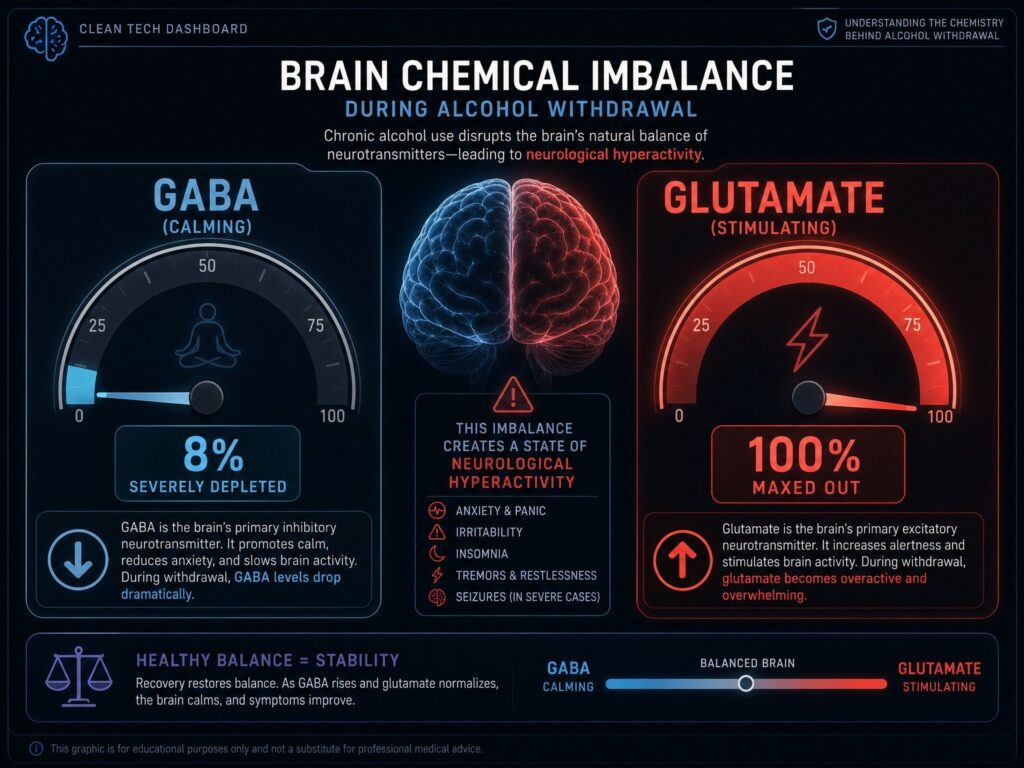
Alcohol is a central nervous system depressant. Drink heavily for long enough and your brain stops treating it as a foreign substance — it starts building around it. Specifically, alcohol enhances the effect of GABA, your brain’s primary calming neurotransmitter, while suppressing glutamate, the one responsible for stimulation. Over time, according to research published in the American Family Physician, the brain compensates by downregulating GABA receptors and amplifying glutamate activity. It’s essentially trying to stay balanced in a system that’s constantly being sedated.
When you suddenly remove alcohol from that equation, the brain doesn’t immediately recalibrate. The GABA suppression is gone, but the glutamate amplification is still running full tilt. The result is a neurological system in a kind of hyperactive panic — which is where withdrawal symptoms come from. Shaking, sweating, racing heart, anxiety that feels almost electric. None of that is weakness or drama. It’s pure neurobiology.
Physical dependence develops differently for everyone, which is why some people can skip a night of drinking and feel fine, while others who drink similar amounts experience debilitating symptoms within hours. The mechanism is the same; the intensity varies wildly based on individual brain chemistry, genetics, and drinking history.
Why Everyone’s Experience Is Different
How severe your withdrawal gets depends on several converging factors: how long you’ve been drinking heavily, how much alcohol you consume daily, your age and overall health status, and whether you’ve gone through withdrawal before. That last one matters more than people realize. Each withdrawal episode can actually sensitize the nervous system further — a phenomenon called “kindling” — making subsequent detox attempts progressively more intense. Someone on their third attempt at quitting may experience significantly worse symptoms than they did the first time, even if their drinking hasn’t changed much.
The Alcohol Withdrawal Timeline at a Glance
Withdrawal doesn’t announce itself dramatically at first. The early phase is almost deceptive.
| Timeframe | What Typically Happens |
| 6–24 hours after last drink | Mild anxiety, hand tremors, sweating, nausea, headache, difficulty sleeping |
| 24–48 hours | Symptoms intensify; risk of seizures increases, particularly grand mal seizures |
| 48–72 hours | Peak danger window; delirium tremens (DTs) can emerge in high-risk individuals |
| 72 hours onward | Gradual improvement for most; DTs can persist for several days if untreated |
According to one of a source overview, roughly 1 in 10 people who develop alcohol withdrawal syndrome will experience seizures. That statistic often shocks people, because the early hours of withdrawal can feel manageable — uncomfortable, yes, but survivable. The danger is that there’s often no reliable warning before symptoms escalate sharply. Someone who powered through the first twelve hours feeling “okay” can move into seizure territory within the next twelve without much transition.
What makes this particularly complicated is that symptoms like anxiety, elevated heart rate, and insomnia can be easy to rationalize away. People tell themselves they’re just stressed, just tired, just need water. Meanwhile the nervous system is operating at a level that puts real strain on the cardiovascular system — blood pressure spikes, heart rhythm abnormalities, the whole cascade. If you’re planning to track your progress through withdrawal alone at home, understanding how long the detox process typically takes changes what “planning” should actually look like.
When Withdrawal Becomes a Medical Emergency
Understanding alcohol withdrawal dangers means recognizing that withdrawal can be more than just uncomfortable. While many people experience mild to moderate symptoms, some develop severe, potentially life-threatening complications that require immediate medical attention. Knowing which warning signs require emergency evaluation can help prevent serious outcomes and ensure timely treatment. The symptoms that require immediate emergency evaluation aren’t subtle:
- Seizures, particularly grand mal seizures, which can cause falls, head injuries, or respiratory failure
- Severe confusion or disorientation that goes beyond “foggy” — genuine inability to recognize surroundings
- Visual, auditory, or tactile hallucinations
- Extreme agitation or combativeness that can’t be explained
- High fever combined with heavy sweating
- Loss of consciousness
These aren’t rare in the way that lightning strikes are rare. In people with significant physical dependence, they’re predictable risks. The NIAAA’s clinical framework for alcohol use disorder is clear that untreated alcohol withdrawal carries real mortality risk — and that risk isn’t distributed evenly. People who’ve had withdrawal seizures before, people who’ve been drinking heavily for years, people with certain underlying health conditions — they’re not playing the same odds as someone quitting a three-month binge.
If any of those symptoms appear, calling 911 or getting to an emergency room is not optional. It’s not an overreaction.
Delirium Tremens Explained in Plain Terms
Delirium tremens — DTs — is the name for the most severe manifestation of alcohol withdrawal, and it’s both rarer and more dangerous than most people expect. Roughly 3% to 15% of people with alcohol use disorder who enter withdrawal will develop DTs, typically emerging between 48 and 72 hours after the last drink.
What actually happens during DTs is a kind of full-system neurological storm. Profound confusion, hallucinations that can be vivid enough to feel completely real, extreme agitation, fever, heavy sweating, and in severe cases, cardiovascular collapse. Harvard Health describes the sensation as similar to a vehicle that can’t slow down — the braking mechanism is gone, and the engine is running at maximum. Without treatment, the mortality rate for delirium tremens can reach 37%. With appropriate medical intervention, that figure drops significantly — but even treated DTs carries a 5–15% fatality rate in serious cases.
I’ll be honest: when people throw around phrases like “cold turkey,” I think they genuinely underestimate what this refers to for someone with severe alcohol dependence. It’s not suffering through a bad flu weekend. It’s potentially removing the one thing keeping a chemically dependent brain from going into shock.
Who Is Most at Risk?
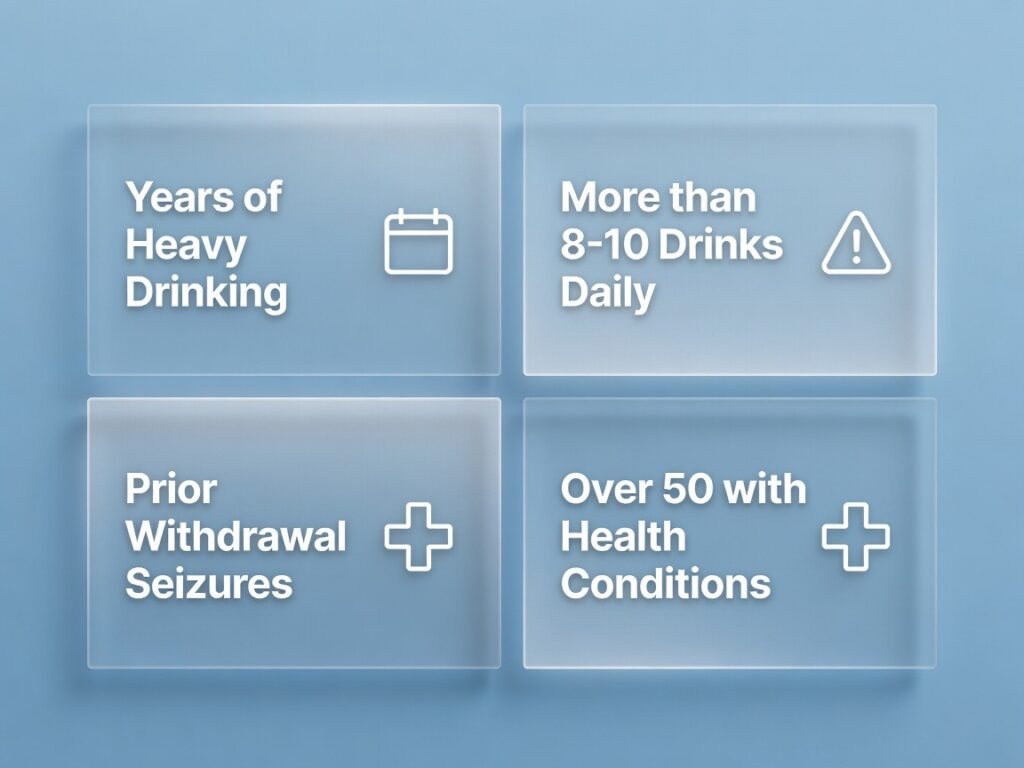
Not everyone who drinks regularly will experience severe withdrawal. But certain patterns and histories raise the risk considerably, and a frank medical assessment is the only way to know where an individual actually falls.
You may benefit from a professional evaluation before attempting to stop drinking if any of the following apply:
- You’ve been drinking heavily for several years, not months
- You drink daily or near-daily, particularly more than 8–10 drinks per day
- You’ve experienced withdrawal symptoms before — even mild ones like shaking or sweating
- You’ve had a withdrawal seizure at any point in the past
- You’re over 50 and have other medical conditions like hypertension, liver disease, or heart problems
- You’ve been through detox previously, since prior withdrawal episodes can increase severity through the kindling effect
The presence of co-occurring mental health conditions — depression, anxiety disorders, trauma history — doesn’t automatically increase physical withdrawal risk, but it does complicate the process. A clinical team that accounts for those layers is going to provide more effective care than a one-size-fits-all approach.
Why Supervised Detox Is Safer Than Going It Alone
The case for medically supervised detox isn’t philosophical. It’s practical. When you detox under medical supervision, the care team can monitor your vital signs continuously, administer benzodiazepines if seizure risk becomes acute, correct electrolyte imbalances through IV supplementation, and intervene if symptoms escalate faster than expected.
Benzodiazepines — particularly diazepam and lorazepam — are the current gold standard for managing alcohol withdrawal syndrome, essentially replacing the GABA activity that alcohol was providing and allowing the brain to recalibrate without the hyperexcitability spike. The clinical protocol for withdrawal management also typically includes thiamine supplementation, because chronic heavy alcohol use depletes B vitamins and can lead to Wernicke-Korsakoff syndrome — a form of brain damage that is entirely preventable with prompt treatment.
Understanding what medications are used during alcohol detox helps demystify the process. It’s not sedation for the sake of sedation — it’s precise pharmacological management of a neurological event. Whether inpatient or outpatient detox is more appropriate depends on individual risk factors, which is yet another reason why a medical evaluation before quitting beats trying to figure it out alone.
What to Do Right Now If You’re Scared to Quit
Fear of withdrawal keeps a lot of people drinking longer than they want to. That’s not weakness — it’s actually reasonable, given that the fear is grounded in real risk. But staying stuck in that loop doesn’t reduce the risk; it usually amplifies it.
The most useful thing you can do right now is talk to a healthcare provider before stopping, not after symptoms start. If you’ve been drinking heavily for an extended period, going in for an assessment is how you find out your actual risk level rather than guessing. If you’re experiencing severe symptoms already — seizures, hallucinations, extreme confusion — that’s an emergency room situation, not a “wait and see.”
If you’re asking can you die from alcohol withdrawal, understanding what happens during the alcohol detox process is a reasonable first step. Medical detox is not a punishment or a sign of failure—it is structured support for a physiological process that can become dangerous without proper care.
Kora Behavioral Health alcohol detox provides a structured environment where individuals can receive support throughout the withdrawal process. For many people, supervised detox is significantly safer and less overwhelming than attempting withdrawal alone. Having medical support allows symptoms to be monitored, potential complications to be addressed quickly, and the focus to remain on moving through withdrawal as safely as possible.
Call (866) 861-9667 if you have questions about medically supervised detox and want to understand what your options look like before making a decision.
Frequently Asked Questions
Can you actually die from alcohol withdrawal?
Severe alcohol withdrawal can be fatal, and the risk is real rather than theoretical. Delirium tremens, the most severe form of withdrawal, carries significant mortality rates without proper treatment. Even with medical care, DTs requires serious clinical management. The NIAAA and the American Psychological Association both emphasize that alcohol use disorder carries life-threatening medical dimensions that go beyond behavioral concerns. Emergency symptoms — seizures, extreme confusion, hallucinations — require immediate medical attention, not home management.
How soon after my last drink do symptoms start?
Mild withdrawal symptoms can begin as early as 6 hours after the last drink. For most people, the first 24 hours bring anxiety, tremors, elevated heart rate, and nausea. The danger window for more severe complications — seizures and delirium tremens — runs from roughly 24 to 72 hours after the last drink. Timing varies meaningfully based on individual factors, which is why people with significant drinking histories should have a clinical team involved before they reach that window, not after symptoms appear.
Is it ever safe to quit drinking on my own?
Some people with mild dependence experience manageable withdrawal without medical supervision. The honest answer, though, is that you cannot reliably predict your own risk level without a clinical evaluation — and the downside of underestimating that risk is severe. People who have been drinking heavily for years, who’ve experienced withdrawal symptoms before, or who’ve had a prior seizure should seek medical guidance before stopping. The SAMHSA National Helpline is a free, confidential resource available 24/7 for anyone trying to figure out where to start.