

When someone finally decides to get help with drinking, the first fear isn’t always about withdrawal. A lot of the time, it’s “what about everything else?” The anxiety that’s been running in the background for years. The depression that somehow feels quieter after a few drinks.
The trauma that nobody’s talked about, the kind that made alcohol feel necessary in the first place. The worry that a detox program will hand over medications for the shaking and sweating, declare success after a week, and send you home with none of that other stuff touched.
That fear is completely legitimate. And it’s exactly why dual diagnosis alcohol detox exists as a distinct, specialized form of care, not just a marketing phrase. Clinical consensus defines it as the simultaneous medical clearing of alcohol while addressing a co-occurring mental health condition, not one after the other, but woven together from the start.
According to Cleveland Clinic, individuals who receive integrated care for both conditions consistently show better outcomes than those whose mental health concerns go unaddressed during addiction treatment. The research is not subtle on this point.
The Link Between Alcohol and Mental Health
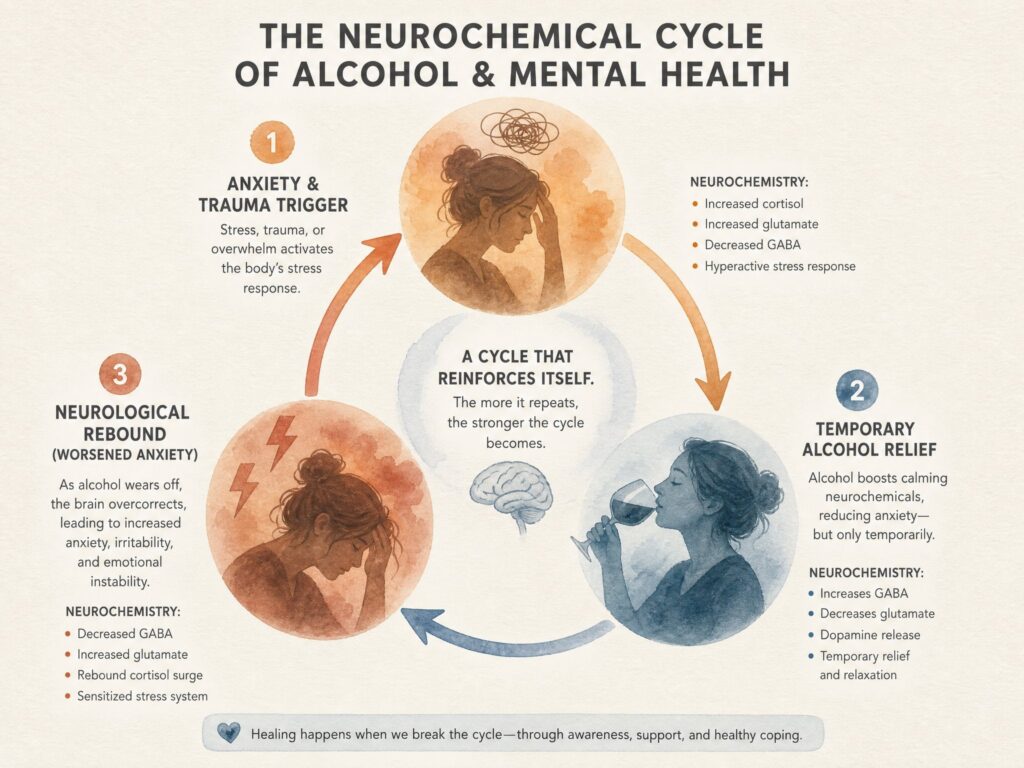
The relationship between alcohol and mental health is not as clean as we’d like it to be. Most people picture it as a chain reaction: someone gets depressed, they start drinking to cope, and things spiral. Sometimes that’s accurate. But the biological reality is messier. Alcohol can also trigger or intensify anxiety disorders over time, even in people who had no prior diagnosis.
The sedative effect that makes the first drink feel like relief becomes the very mechanism that deepens neurological dependency, and when the alcohol clears, the brain rebounds, flooding the system with anxiety signals that are often worse than whatever the person felt before they started drinking.
Trauma adds another layer. People who’ve experienced adverse life events, whether childhood neglect, assault, or chronic stress, frequently develop dysregulated stress responses. Alcohol quiets that dysregulation temporarily. It’s not a moral failing. It’s neurochemistry.
The substance use and the mental health condition start feeding each other in a loop that’s genuinely difficult to interrupt unless you’re addressing both simultaneously.
Depression and alcohol use disorder appear together at a striking rate, partly because both involve disruptions to the dopamine and serotonin systems. The person isn’t necessarily drinking because they’re sad.
The alcohol may be actively suppressing whatever capacity they had for emotional regulation, and what looks like depression might be partially a withdrawal symptom, partially a pre-existing condition, or both. Untangling that distinction requires clinical assessment, not guesswork.
Why People Need More Than Withdrawal Management
Withdrawal management is about physical safety. Getting someone through the neurological storm of alcohol cessation without a seizure, without dangerous blood pressure spikes, without the rare but fatal complications of severe alcohol withdrawal syndrome.
That part is non-negotiable, and it requires medical supervision during alcohol detox, not a DIY approach. But the physical stabilization is a starting line, not a finish line. Someone who exits detox still carrying unaddressed anxiety disorder, unresolved trauma, or untreated depression faces a recovery that’s built on sand.
Why Treating One Without the Other May Not Be Enough
The data on this is uncomfortable. Research published in the Journal of Dual Diagnosis found that dually diagnosed patients who only received addiction treatment were roughly twice as likely to experience poor outcomes, including relapse or re-hospitalization, compared to those whose mental health conditions were treated at the same time. That’s not a minor statistical footnote. It’s a structural flaw in the traditional detox model.
Standard withdrawal management does not ask why someone drank. It manages the physiological consequences of stopping. That’s valuable, but it leaves a critical gap. If the depression lifts slightly once the alcohol clears and then crashes back, the pull toward drinking again becomes almost gravitational.
If the anxiety disorder was being self-medicated and no replacement strategy exists, the discomfort becomes unbearable. The substance use wasn’t the whole problem. It was one layer of a multi-layered set of challenges.
The National Alliance on Mental Illness has been vocal on exactly this point, noting that treating addiction in isolation from mental health conditions is largely ineffective for sustained recovery. Their advocacy for integrated treatment is grounded in decades of clinical pattern-recognition. Co-occurring disorders don’t behave like separate problems that can be scheduled one at a time. They interact constantly.
Recovery Requires Understanding the Whole Person
That means accounting for personal history, emotional patterns, what kind of support systems exist outside treatment, and what the person actually wants their life to look like after detox. A clinical team that only sees a substance use problem is working with incomplete information. Recovery goals vary significantly between individuals, and individualized care planning starts with that full picture, not just the drinking history.
What Dual Diagnosis Detox Looks Like
It starts with a comprehensive assessment, and not the kind where someone fills out a form in a waiting room. A thorough intake for co-occurring disorders treatment should capture mental health history, current symptoms, trauma history, medication history, and substance use patterns together, because each informs the others.
From there, the clinical team, which in a well-designed program includes medical doctors, psychiatrists, and therapists working in coordination, creates a treatment plan that addresses withdrawal monitoring and behavioral health at the same time.
SAMHSA emphasizes that alcohol withdrawal can actually mask, mimic, or temporarily worsen psychiatric symptoms, which makes the assessment phase particularly important. Someone who appears severely depressed in the first forty-eight hours of detox might be experiencing withdrawal-induced dysphoria rather than a clinical mood disorder. Or they might have both. A coordinated care team knows the difference, and that distinction shapes everything about how treatment proceeds.
When considering detox with depression and anxiety, medication decisions are made within the broader context of each person’s medical and mental health needs. Some individuals receive medications to manage withdrawal symptoms, while others may need existing psychiatric medications reviewed, continued, or adjusted during the detox process.
Understanding what to expect from alcohol detox medications before entering treatment can help reduce uncertainty and provide a clearer picture of how physical withdrawal and co-occurring mental health concerns may be addressed together.
How Dual Diagnosis Care Differs From Standard Detox
| Standard Detox Focus | Dual Diagnosis Detox Focus |
| Withdrawal safety and physical stabilization | Withdrawal safety + mental health needs addressed simultaneously |
| Medically managed symptom relief | Psychiatric evaluation and individualized behavioral health planning |
| Short-term physical stabilization | Coordinated care connecting detox to ongoing mental health recovery |
| General treatment protocols | Individualized care built around co-occurring conditions |
Conditions Commonly Treated Alongside Alcohol Detox
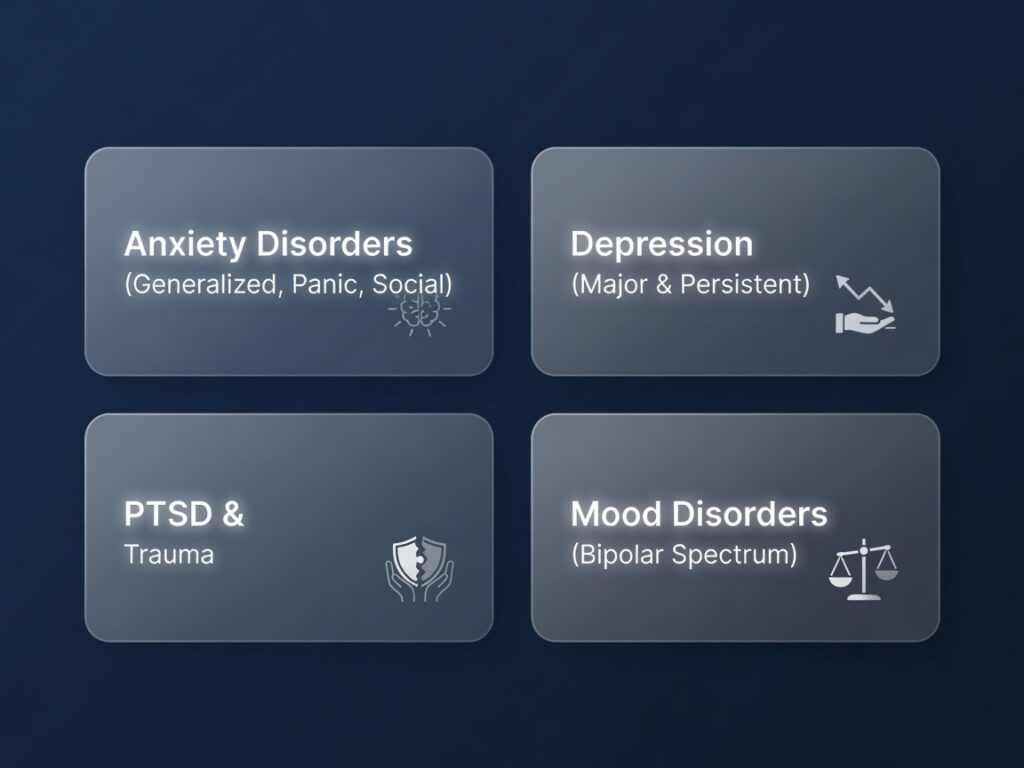
Anxiety disorders, including generalized anxiety, panic disorder, and social anxiety, appear with alcohol use disorder at some of the highest co-occurrence rates of any diagnostic pairing. Depression, whether major depressive disorder or persistent depressive disorder, is similarly common. Then there’s PTSD, which carries its own complexity because trauma symptoms can intensify during withdrawal and require trauma-informed clinical responses rather than standard detox protocols.
Mood disorders more broadly, including bipolar spectrum conditions, require particular attention during detox because alcohol can destabilize mood significantly, and withdrawal can mimic or exacerbate mood episode features. Other behavioral health challenges, including anxiety-adjacent presentations like OCD or social phobia, also frequently appear alongside alcohol use disorder.
A few things worth saying plainly:
- Having a mental health condition does not disqualify someone from recovery. It means the clinical team needs accurate information to plan appropriate care.
- Symptoms that appear during detox may or may not reflect a pre-existing mental health condition. Professional assessment is what resolves that uncertainty.
- Each person’s combination of conditions is genuinely individual, which is why treatment plans that work well for one person may look quite different from what another person needs.
- Anxiety and alcohol use disorder together don’t automatically predict a harder recovery. Integrated treatment exists precisely because the combination is recognizable and treatable.
Therapies Used in Integrated Care
Therapy in dual diagnosis detox isn’t reserved for a later phase of treatment. It begins during the detox process itself, because behavioral health support during the physically vulnerable period of withdrawal can meaningfully affect how a person moves through it.
Individual counseling during this phase often focuses on stabilization, understanding what’s happening in the body and mind, and beginning to build a language for the emotional material that surfaces when alcohol clears.
Group therapy, when clinically appropriate during early treatment, serves a different function. There’s something specific that happens when a person realizes other people are navigating similar overlapping struggles, the anxiety alongside the substance use, the depression that preceded the drinking, the trauma that nobody outside the room understands. That recognition is therapeutic in a way that even excellent individual sessions can’t replicate.
Trauma-informed approaches matter considerably here. Trauma-informed care doesn’t mean trauma processing necessarily happens during detox. It means clinical staff understand how trauma affects the nervous system, how withdrawal can reactivate trauma responses, and how to structure the treatment environment in ways that don’t inadvertently re-traumatize. Emotional regulation skill development, mindfulness-based approaches, and coping skill work often begin during this phase as well, building the foundation for what happens in ongoing treatment after detox ends.
Relapse prevention planning is part of this picture too, though it lands differently when it accounts for mental health factors rather than just substance use triggers. Understanding what comes next after detox is important for this reason. Detox is stabilization. The therapeutic work that follows is where the longer-term recovery actually takes shape.
Choosing a Dual-Diagnosis-Capable Detox Center
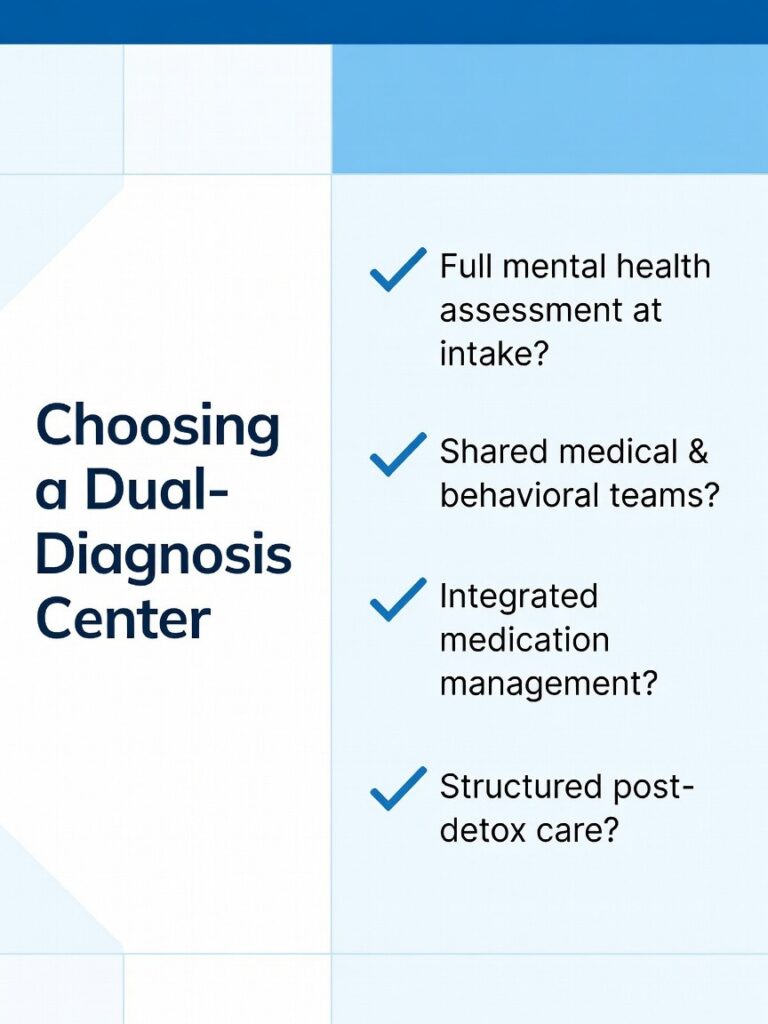
Not every detox program that lists “dual diagnosis” on its website delivers what that phrase implies. Some programs offer a single psychiatric evaluation and call it comprehensive care. Others have genuinely integrated clinical teams where psychiatrists and therapists communicate daily about each patient’s status. The difference matters enormously, and it’s worth asking direct questions before admission.
Questions worth asking any program you’re considering:
- Does the center conduct a full mental health assessment at intake, or is it limited to substance use history?
- Are medical and behavioral health services coordinated through shared clinical teams, or siloed into separate departments?
- How does the program handle medications for both withdrawal and mental health conditions together?
- Is there a structured plan for continued care after detox, including outpatient programs or higher levels of support if needed?
- Are clinical staff trained specifically in co-occurring disorders, or is mental health support an add-on?
Why Integrated Care Matters for Long-Term Recovery
Integrated behavioral health treatment gives the clinical team a fuller picture of the individual, which means the treatment plan addresses more of the actual recovery landscape. The transition from detox into ongoing outpatient programs or residential care is smoother when the co-occurring disorder has already been assessed and incorporated into the plan.
Recovery built on that kind of foundation tends to hold better over time, not because dual diagnosis treatment is a guarantee, but because it’s working with more of the truth.
If you want to locate additional resources or verify provider credentials, the SAMHSA National Helpline at 800-662-4357 is a confidential resource for treatment referrals and information.
Ask About Kora Behavioral Health’s Dual-Diagnosis Detox Approach
Kora Behavioral Health alcohol detox recognizes that mental health and alcohol use are often deeply connected. Treating them as separate issues or waiting to address one after the other can leave important needs unmet during a critical stage of recovery. Kora Behavioral Health provides individualized care with coordinated support for both withdrawal management and mental health needs from the beginning of treatment.
Kora serves Lancaster and Central Pennsylvania, including communities in York, Harrisburg, Hershey, Reading, and Lebanon. If you’re evaluating care options, the best starting point is a direct conversation, before admission, before commitment, just a confidential exchange about what’s actually going on and what treatment could realistically look like.
Call (866) 861-9667 to ask about our integrated dual-diagnosis detox approach.
Frequently Asked Questions
What is dual diagnosis treatment?
Dual diagnosis treatment addresses both a substance use disorder and a co-occurring mental health condition at the same time rather than sequentially. Instead of treating addiction first and mental health concerns later, integrated treatment recognizes that both conditions influence each other and require simultaneous clinical attention. Treatment plans are individualized based on each person’s specific combination of conditions, history, and recovery needs. The goal is coordinated care that accounts for the whole picture rather than separate tracks running independently.
Can detox treat my anxiety or depression too?
Detox primarily focuses on safely managing alcohol withdrawal, which is a medical priority. Mental health concerns can absolutely be evaluated and supported during the detox process, and in a dual diagnosis program, that evaluation happens from the start. What detox can’t fully resolve is a complex anxiety disorder or depressive condition that developed over years. Those require ongoing treatment beyond detox. What integrated care ensures is that those conditions are identified, assessed, and incorporated into the plan for continued care rather than ignored until a later phase.
Why does mental health matter during detox?
Because withdrawal doesn’t happen in a vacuum. Anxiety symptoms can intensify dramatically when alcohol clears. Depression can surface or deepen. Trauma responses can become more acute without the suppressive effect of alcohol. Understanding a person’s mental health history and current condition allows the clinical team to anticipate those responses, manage them appropriately, and adjust the treatment approach accordingly. Without that information, clinicians are working blind during a period when accurate assessment is most critical.